

Forklift Attachments: How the Right Equipment Can Improve Productivity and Material Handling
How the Right Forklift Attachments Improve Material Handling Efficiency
A forklift may be one of the most versatile pieces of equipment in a warehouse, distribution center, or manufacturing facility, but the forklift itself is only part of what determines how effectively it can perform a job
The attachment installed on the forklift can significantly impact how efficiently materials are moved, how safely loads are handled, and how much productivity operators can achieve throughout a shift.
Standard forks work well for many applications, but businesses handling specialized products, unusual loads, or high-volume operations may benefit from attachments designed specifically for those tasks.
Understanding the different types of forklift attachments and choosing the right solution for your operation can help improve productivity while allowing businesses to get more from their material handling equipment.
Lift Solutions works with businesses across Nebraska, Iowa, Colorado, Kansas, South Dakota, and surrounding service coverage areas to help identify forklifts, attachments, and material handling solutions that match the demands of their operations.
Why Forklift Attachments Matter
Warehouses handle an enormous variety of products.
Palletized inventory may be the most common, but many businesses also move rolls, cartons, drums, appliances, construction materials, bulk products, and other loads that are difficult to handle with standard forks alone.
The right attachment can help a forklift perform specialized tasks more efficiently.
Depending on the application, forklift attachments may help:
- Reduce unnecessary material handling
- Improve operator control
- Increase productivity
- Reduce product damage
- Handle specialized loads
- Improve load positioning
- Expand the capabilities of existing equipment
Choosing an attachment should always begin with understanding the load and how the forklift is being used.
Sideshifters Improve Load Positioning
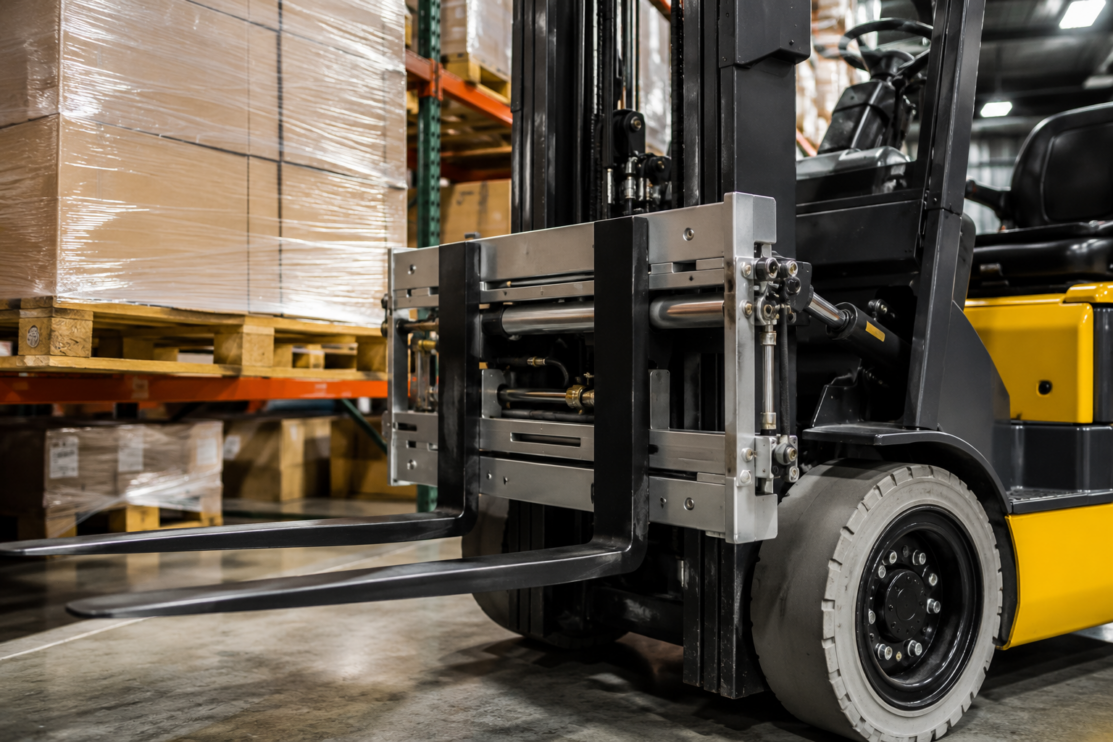
A sideshifter allows the forks to move horizontally from side to side without requiring the operator to reposition the entire forklift.
This relatively simple capability can make a significant difference in busy warehouse environments.
Operators can make small adjustments when placing or retrieving pallets, which can help improve positioning accuracy and reduce unnecessary forklift movement.
Sideshifters can be especially valuable when working with pallet racking where precise placement is important.
Fork Positioners Reduce Manual Adjustments
Different pallet and load sizes often require operators to adjust the distance between the forks.
Without a fork positioner, these adjustments may need to be performed manually.
Fork positioners allow operators to change fork spacing from the operator compartment, helping equipment adapt more quickly to different load dimensions.
For operations handling multiple pallet sizes throughout the day, this can reduce delays and improve productivity.
Clamps Help Handle Specialized Products
Not every product is transported on a traditional pallet.
Clamp attachments can be designed to handle certain products by securely gripping the load.
Depending on the application, clamp-style attachments may be used for materials such as:
- Cartons
- Paper rolls
- Appliances
- Drums
- Other specialized products
Because these attachments interact directly with the load, selecting the correct attachment and operating it properly are particularly important.
Rotators Add Another Level of Flexibility
Some operations need the ability to rotate or invert materials during handling.
Rotator attachments allow a forklift carriage to rotate a load for applications involving containers, bins, manufacturing materials, waste handling, or other specialized processes.
For businesses that regularly perform these tasks, a rotator can eliminate additional handling steps and make the process more efficient.
Specialized Forks Can Make a Difference
Even the forks themselves should be selected based on the application.
Fork length, width, thickness, capacity, and configuration all affect how loads are handled.
Using forks that are not appropriate for the load can affect stability and equipment performance.
Businesses should evaluate the types of pallets and materials they routinely handle when determining the correct fork configuration.
Attachments Can Affect Forklift Capacity
One of the most important considerations when adding an attachment is its effect on the forklift’s rated capacity.
Attachments add weight and can change the load center and handling characteristics of the forklift. As a result, the amount of weight the forklift can safely handle may change.
This is why businesses should not simply install an attachment because it physically fits the equipment.
The forklift, attachment, load, and application need to be evaluated together.
The equipment’s data plate and capacity information must accurately reflect the forklift’s approved configuration.
Consider Visibility and Maneuverability
Attachments can also affect what the operator sees from the driver’s position.
Larger attachments may reduce forward visibility or change how an operator approaches a load.
They can also affect the overall dimensions and maneuverability of the equipment.
These factors become particularly important in:
- Narrow aisles
- Congested warehouses
- High-density racking
- Busy loading areas
- Facilities with pedestrian traffic
Selecting the right attachment means considering the entire operating environment, not just the load itself.
Operator Training Is Essential
Whenever equipment configuration changes, operators need to understand how that change affects forklift operation.
An attachment may alter:
- Capacity
- Load handling
- Visibility
- Turning characteristics
- Load positioning
- Operating procedures
Operators should be trained on the equipment and attachment they are expected to use.
Proper training helps businesses maximize the benefits of an attachment while supporting safe operation.
Maintain Forklift Attachments Along With the Forklift
Attachments are working components and should be included in routine equipment inspections and maintenance.
Depending on the attachment, inspections may include:
- Hydraulic connections
- Mounting points
- Wear components
- Fork condition
- Moving components
- Structural condition
Identifying wear or damage early can help prevent equipment problems and unexpected downtime.
The Right Attachment May Reduce the Need for Additional Equipment
In some situations, adding the appropriate attachment can allow an existing forklift to perform tasks that would otherwise require additional equipment or material handling steps.
That does not mean every forklift should be configured to perform every task.
Instead, businesses should evaluate whether specialized attachments can make frequently performed tasks more efficient.
When matched correctly to the application, an attachment can increase the versatility and value of existing equipment.
Evaluate the Entire Application Before Choosing an Attachment
Selecting a forklift attachment should involve more than choosing a product from a catalog.
Businesses should consider:
- What materials are being moved
- Load dimensions and weights
- How frequently the task is performed
- Forklift specifications
- Required lift heights
- Available aisle space
- Operator visibility
- Existing warehouse workflows
Evaluating these factors helps ensure the attachment supports the operation rather than creating new limitations.
How Lift Solutions Can Help
The best material handling equipment is equipment that fits the job it is expected to perform.
Lift Solutions helps businesses evaluate forklifts, attachments, warehouse equipment, and operational requirements to identify solutions designed around real-world applications.
Whether a company needs to improve pallet handling, manage specialized loads, expand the capabilities of an existing forklift, or select equipment for a new application, the Lift Solutions team can help evaluate the available options.
With equipment, parts, service, rentals, warehouse solutions, and material handling expertise, Lift Solutions works with businesses to build systems that improve productivity while supporting long-term operational needs.
Get More From Your Forklift Fleet
Forklifts are designed to move materials, but the right attachment can make them significantly more versatile.
From sideshifters and fork positioners to clamps, rotators, and specialized forks, attachments can help businesses handle materials more efficiently while reducing unnecessary movement and improving operator productivity.
The key is choosing an attachment that is properly matched to the forklift, load, and operating environment.
By evaluating the entire application instead of focusing solely on the forklift, businesses can build a more efficient material handling operation and get greater value from the equipment they already use.


