

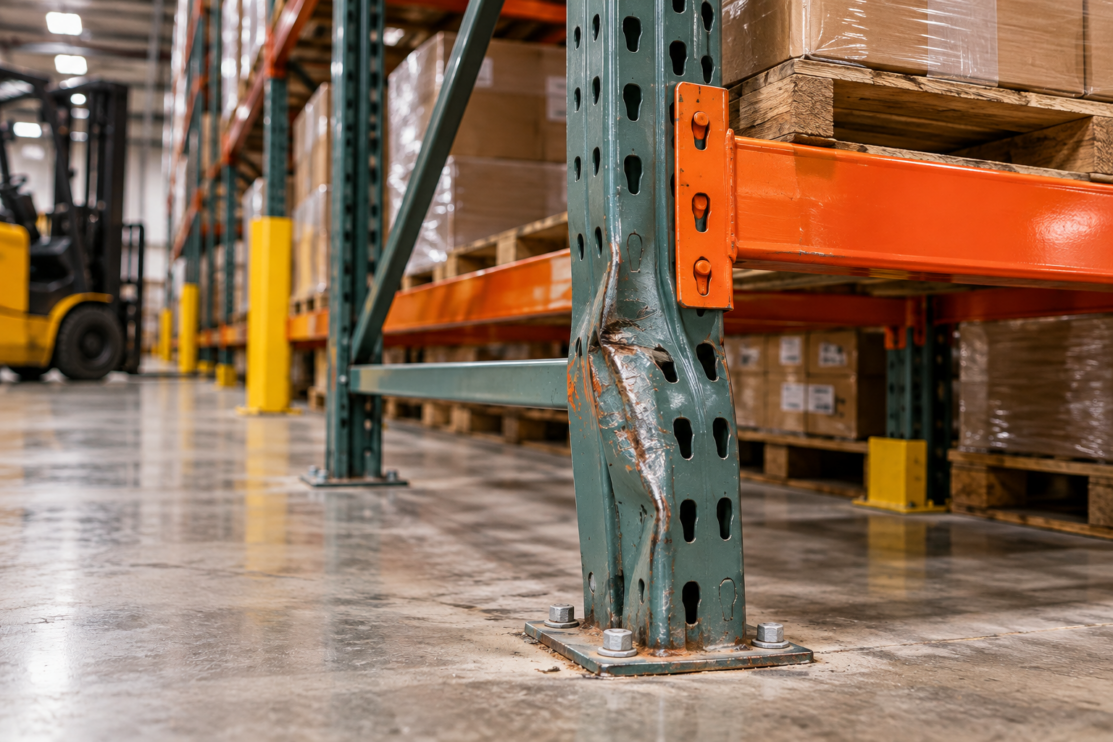
Warehouse pallet racking is designed to support significant weight while keeping inventory organized and accessible. In busy warehouses, distribution centers, and manufacturing facilities, these systems play an essential role in everyday operations.
However, pallet racking is not immune to damage.
Forklift impacts, improper loading, changing inventory requirements, and years of daily use can affect the condition of a warehouse’s storage systems. Some damage is immediately noticeable, while other issues may develop gradually and go unnoticed until a more serious problem occurs.
A bent upright or damaged beam may not seem like an urgent concern when the rack is still standing and supporting inventory. However, visible damage can affect a rack system’s structural capacity and should never be ignored.
Understanding when warehouse rack repair is necessary can help businesses address potential hazards, protect inventory, and maintain efficient material handling operations.
Lift Solutions provides warehouse equipment, pallet racking solutions, rack repair, and warehouse design services to help businesses maintain storage systems that support their operations.
Why Warehouse Rack Condition Matters
Pallet racking is more than a place to store inventory.
It is an engineered storage system designed to support specific loads under particular conditions.
The uprights, beams, connectors, bracing, and other components work together to support the weight of stored materials.
When one component becomes damaged, the effects may extend beyond the visibly affected area.
For example, an impact that bends an upright can alter how loads are distributed through the structure. Damage to a beam connector can affect how securely that beam is attached to the rack.
These concerns become particularly important in warehouses where heavy pallets are stored at significant heights.
Maintaining rack condition helps businesses protect employees, equipment, inventory, and the surrounding operation.
Common Causes of Warehouse Pallet Rack Damage
Rack damage can occur for several reasons.
Understanding the most common causes can help businesses identify where additional inspections or protective measures may be needed.
Forklift Impacts
Forklifts operate close to pallet racking throughout the day.
During loading, unloading, and travel, equipment may come into contact with uprights, beams, or other rack components.
Even relatively minor impacts can cause damage.
Repeated contact in the same area may gradually weaken components or create conditions that require professional evaluation.
Improper Loading
Pallet racking is designed around specific load capacities and configurations.
Exceeding those limits or distributing weight incorrectly can place excessive stress on the system.
Changes in inventory weight, pallet dimensions, or storage practices can also affect how loads are supported.
Businesses should verify that their storage systems remain appropriate for the materials being stored.
Equipment and Layout Changes
A warehouse may introduce larger forklifts, new attachments, or different material handling equipment.
Those changes can affect aisle clearance and how easily operators maneuver around existing racking.
A layout that worked well with one type of forklift may create challenges when equipment requirements change.
Normal Wear and Facility Conditions
Although pallet racking is designed for industrial environments, long-term exposure to moisture, corrosion, repeated loading, and other conditions can affect its condition.
Regular inspections help identify developing concerns before they become larger problems.
Sign #1: Bent or Damaged Rack Uprights
Uprights are among the most important structural components of a pallet racking system.
They transfer loads from the beams to the floor and help maintain the structure’s stability.
Unfortunately, uprights are also particularly vulnerable to forklift impacts because they are located near travel aisles and loading areas.
Warning signs may include:
- Visible bending
- Dents or deformation
- Twisted sections
- Damaged base plates
- Loose or missing anchors
- Cracked welds
- Corrosion or material deterioration
Damage near the base of an upright deserves particular attention because this area is frequently exposed to equipment impacts.
A visibly damaged upright should be evaluated by a qualified rack professional. Depending on the condition and system design, repair or replacement may be necessary.
Sign #2: Damaged or Deflected Rack Beams
Horizontal beams support the pallets and transfer their weight to the uprights.
Beam damage can occur through impacts, improper loading, or other operational conditions.
Some beam deflection under load may be normal within manufacturer specifications. However, excessive deflection, permanent bending, twisting, or visible damage should be investigated.
Businesses should also watch for damage around beam connectors.
If a beam is not properly secured to the upright, the integrity of the storage position may be affected.
Operators and warehouse personnel should report unusual beam conditions rather than assuming the rack remains safe because it is still holding inventory.
Sign #3: Missing or Damaged Safety Components
Pallet racking systems often include safety components designed to help maintain proper connections and protect the structure.
Depending on the system, these may include beam locking devices, anchors, row spacers, pallet supports, and other components.
Missing or damaged components can affect how the system performs.
For example, beam locking devices help prevent unintended beam disengagement.
Anchors help secure rack uprights to the floor according to the system’s engineered design.
If these components are missing, loose, or damaged, the condition should be evaluated and corrected using compatible, approved components.
Sign #4: Repeated Damage in the Same Location
Sometimes the most important warning sign is not the severity of a single impact.
It is the frequency of damage in a particular area.
A warehouse may repeatedly experience rack damage near:
- Busy intersections
- Loading docks
- Narrow aisles
- Staging areas
- High-traffic picking locations
- Tight turning areas
- Entry and exit points
When the same rack locations are damaged repeatedly, the issue may involve more than operator behavior.
Aisle width, traffic patterns, equipment selection, or storage layout may be contributing to the problem.
Repairing the rack addresses the immediate concern, but reviewing the surrounding operation may help reduce future damage.
Sign #5: Changes to the Original Rack Configuration
Warehouse storage requirements rarely remain the same forever.
Businesses add products, change pallet sizes, adjust beam heights, and reorganize storage areas.
However, changes to a pallet racking system can affect its capacity and performance.
Moving beams, changing load configurations, combining components from different manufacturers, or modifying rack structures without appropriate evaluation can create problems.
A rack system should not be assumed to retain its original load capacity after significant modifications.
Businesses planning changes should work with qualified professionals to verify that the revised configuration is appropriate for the intended loads.
When Does Warehouse Rack Repair Make Sense?
Not every damaged rack component requires replacing an entire storage system.
In some situations, an engineered repair solution may be appropriate.
The decision depends on several factors, including:
- Type of damage
- Location of damage
- Severity of deformation
- Rack manufacturer and design
- Load requirements
- Condition of surrounding components
- Availability of compatible replacement parts
- Feasibility of an approved repair
Certain upright damage may be addressed using engineered repair systems specifically designed for the application.
Other damage may require replacing the affected component or a larger section of racking.
Repairs should be evaluated and designed by qualified professionals using solutions appropriate for the rack system and its intended loads.
Warehouse employees should not attempt to straighten, weld, or modify damaged structural components without an approved engineered repair procedure.
When Should Pallet Racking Be Replaced?
Sometimes replacement provides a more appropriate solution than repair.
This may be the case when damage is extensive, multiple structural components are affected, or the existing system no longer meets operational requirements.
Replacement may also deserve consideration when:
- The rack system has widespread deterioration
- Compatible components are unavailable
- Previous modifications have compromised the configuration
- Storage requirements have changed significantly
- The existing layout no longer supports efficient operations
- Repair costs approach the cost of replacement
- The system cannot be restored to an acceptable condition through an approved repair
The goal should not simply be to restore the rack’s appearance.
It should be to ensure the storage system is appropriate for its intended use.
Why Regular Pallet Rack Inspections Matter
One of the most effective ways to identify warehouse rack damage is through regular inspections.
Warehouse employees work around pallet racking every day, making them an important part of recognizing visible problems.
Employees should know how to report concerns such as damaged uprights, bent beams, missing components, and evidence of equipment impacts.
Businesses should also establish a process for qualified personnel to evaluate rack condition.
Inspection frequency should reflect the facility’s operating conditions, equipment traffic, risk exposure, and applicable requirements.
A warehouse with frequent forklift activity may require a different inspection approach than a lower-traffic storage facility.
The important part is having a consistent process for identifying, documenting, and addressing damage.
What Should Happen When Rack Damage Is Discovered?
When damage is identified, businesses should avoid assuming the affected rack can continue operating normally.
The appropriate response depends on the severity and location of the damage.
If structural integrity may be compromised, the affected area should be isolated and protected from further use until qualified personnel can evaluate it.
Loads should not be added to damaged rack positions, and any unloading or corrective work should be performed using a safe, approved procedure.
A qualified rack professional can help determine whether the system requires repair, replacement, or additional evaluation.
Documenting the damage and corrective action can also help businesses identify recurring issues over time.
Rack Protection Can Help Reduce Future Damage
Repairing damaged racking is important, but preventing repeated damage deserves attention as well.
Warehouse protection systems may include:
- Upright protectors
- Column guards
- End-of-aisle protection
- Guardrails
- Bollards
- Traffic barriers
- Clearly marked travel paths
The appropriate protection depends on the warehouse layout and the types of equipment operating nearby.
For example, rack ends exposed to frequent forklift traffic may benefit from protective barriers designed for that location.
These solutions should be considered as part of the overall warehouse design rather than installed without evaluating how they affect aisle clearance and traffic flow.
Forklift Selection Can Affect Rack Damage
The relationship between forklifts and warehouse racking is important.
Different forklifts have different turning characteristics, dimensions, and operating requirements.
Equipment that is poorly matched to aisle widths or storage configurations can make material handling more difficult.
This may increase the likelihood of contact with surrounding structures.
Businesses should evaluate whether their existing forklifts are appropriate for the rack layout.
In some situations, changing equipment or modifying the storage configuration may improve maneuverability and reduce unnecessary congestion.
The objective is to create a warehouse where equipment and storage systems work together.
Warehouse Design Can Address Recurring Problems
If rack damage occurs frequently, a broader facility evaluation may reveal opportunities for improvement.
For example, a warehouse may have narrow turning areas near loading docks or staging locations that force forklifts to make difficult maneuvers.
Inventory may be positioned in ways that create unnecessary traffic through certain aisles.
High-demand products may require repeated access to storage positions that were not designed for that level of activity.
Changes to warehouse layout, storage placement, traffic patterns, or equipment selection may help address these problems.
Lift Solutions provides warehouse layout and design capabilities that can help businesses evaluate their storage systems and broader material handling operations.
Rather than focusing only on the damaged component, businesses can consider why the damage occurred and whether changes could help prevent it from happening again.
How Lift Solutions Supports Warehouse Rack Repair
Warehouse racking is an important part of the overall material handling operation.
When storage systems become damaged or no longer meet the needs of the facility, businesses need solutions that consider both structural requirements and everyday workflow.
Lift Solutions provides warehouse equipment, pallet racking solutions, rack repair, warehouse design, and material handling equipment.
Its broader equipment and warehouse capabilities allow businesses to evaluate storage requirements alongside forklift operations, inventory movement, and facility layout.
Whether a facility needs an existing rack system evaluated, damaged components addressed, or an entirely new storage configuration, Lift Solutions can help businesses explore appropriate solutions.
Lift Solutions works with businesses across Nebraska, Iowa, Colorado, Kansas, South Dakota, and surrounding service coverage areas to support their material handling needs.
Protect Your Warehouse by Addressing Rack Damage Early
Damaged pallet racking should never be treated as a normal part of warehouse operations.
Bent uprights, damaged beams, missing components, and repeated forklift impacts can all indicate that a storage system needs attention.
Identifying problems early gives businesses an opportunity to evaluate the damage and determine the appropriate next step.
In some situations, an engineered repair may be appropriate.
In others, replacing damaged components or redesigning the storage system may provide a better long-term solution.
Regular inspections, employee awareness, appropriate equipment selection, and thoughtful warehouse design can all help reduce the risk of recurring problems.
If your facility has damaged pallet racking or needs to evaluate its current storage system, contact Lift Solutions to discuss warehouse rack repair, replacement, and storage solutions designed around your operation.


