

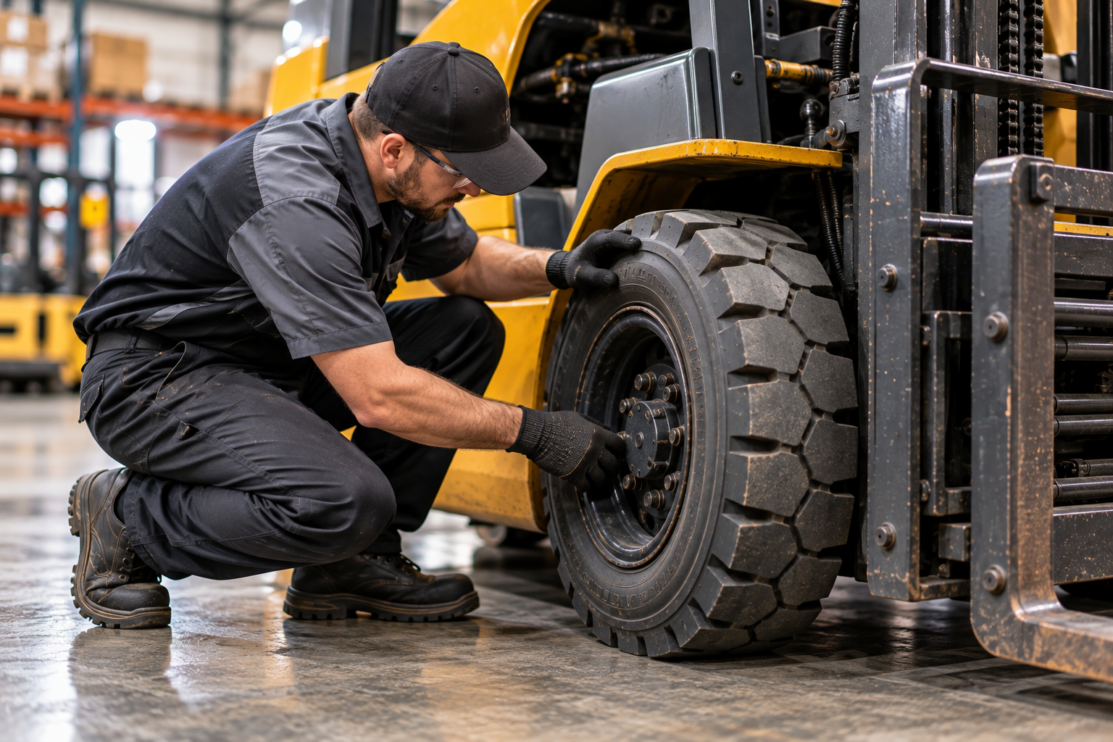
How to Recognize Forklift Tire Problems Before They Affect Your Operation
Forklift tires are easy to overlook until something goes wrong.
Unlike passenger vehicles, forklifts operate under demanding conditions that can place significant stress on their tires. Heavy loads, frequent turning, constant stopping and starting, uneven surfaces, and long operating hours can all contribute to tire wear.
Because forklifts typically operate at relatively low speeds, tire condition may not always receive the same attention as other equipment components.
However, worn or damaged forklift tires can affect much more than the ride.
Tire condition can influence equipment stability, operator comfort, material handling efficiency, and maintenance costs. In some cases, continuing to operate equipment with damaged tires can also place unnecessary stress on other forklift components.
Knowing when to replace forklift tires is an important part of maintaining reliable material handling equipment.
Lift Solutions provides forklift tires, wheels, parts, and service to help businesses keep their equipment operating safely and efficiently.
Why Forklift Tire Condition Matters
Forklift tires are designed to support heavy loads while allowing equipment to maneuver through warehouses, manufacturing facilities, distribution centers, and industrial environments.
Unlike automotive tires, many forklift tires do not rely on air pressure to support the load.
Instead, they use specialized rubber compounds and construction designed for industrial applications.
As these tires wear, their performance characteristics can change.
Excessive wear can contribute to:
- Reduced traction
- Increased vibration
- Less comfortable operation
- Additional stress on equipment components
- Changes in forklift handling
- Greater risk of tire-related downtime
- Potential damage to warehouse floors
The condition of a forklift’s tires should be evaluated regularly rather than waiting for an obvious failure.
Understanding Different Types of Forklift Tires
Not every forklift uses the same type of tire.
The appropriate tire depends on the equipment, operating environment, load requirements, and application.
Cushion Tires
Cushion tires are commonly found on forklifts operating indoors on relatively smooth surfaces.
These solid rubber tires are generally smaller than pneumatic-style tires and are designed for equipment operating in warehouses and manufacturing facilities.
Cushion tire forklifts are often used where maneuverability is important and floor conditions are predictable.
Because cushion tires are solid, they do not experience traditional air-pressure-related flats.
However, they still wear down over time and eventually require replacement.
Pneumatic Tires
Pneumatic-style tires are commonly associated with forklifts operating outdoors or on more demanding surfaces.
They generally provide greater ground clearance and can be better suited for certain industrial environments.
Pneumatic tires may be air-filled or solid, depending on the equipment and application.
Air-filled tires require attention to inflation pressure and potential punctures, while solid pneumatic tires eliminate the risk of air loss but still experience wear and damage.
Choosing the correct tire type is important for equipment performance and reliability.
Sign #1: Visible Tire Wear
One of the most obvious signs that forklift tires may need replacement is visible wear.
Over time, tires gradually lose material through normal operation.
However, excessive wear can affect the forklift’s performance and handling.
Operators and maintenance personnel should watch for:
- Tires worn near or beyond manufacturer wear indicators
- Uneven tread wear
- Significant flattening
- Exposed internal material
- Irregular tire surfaces
- Excessive wear on one side
Many cushion tires include wear indicators that help identify when replacement is necessary.
Because replacement criteria vary by tire manufacturer and construction, businesses should follow the applicable manufacturer’s guidelines rather than relying on a universal measurement.
A qualified forklift service provider can help evaluate whether a tire has reached the end of its usable life.
Sign #2: Cracks, Cuts, or Missing Rubber
Forklift tires operate in environments where they may encounter debris, sharp objects, uneven surfaces, and repeated impacts.
Over time, this can result in visible damage.
Small surface imperfections do not always mean immediate replacement is required, but significant cracking, deep cuts, missing chunks of rubber, or other structural concerns should be evaluated.
Damage can become particularly concerning when it affects the tire’s ability to support the equipment properly.
Operators should report visible tire damage during pre-operation inspections.
If a tire appears unsafe, the forklift should be removed from service until it has been evaluated by qualified personnel.
Sign #3: Excessive Vibration During Operation
Forklift operators often notice tire problems before anyone else.
One common warning sign is an increase in vibration.
As tires wear unevenly or develop flat spots, the forklift may no longer travel as smoothly as it once did.
Operators may experience:
- Increased vibration through the seat
- Rougher travel across smooth floors
- Unusual bouncing
- Changes in steering feel
- Increased operator fatigue
Although these symptoms can have several causes, tire condition should be part of the inspection.
Continued vibration may also contribute to unnecessary stress on other equipment components.
Addressing the underlying problem early can help prevent additional maintenance concerns.
Sign #4: Uneven Tire Wear
Uneven tire wear deserves attention because it may indicate more than normal tire deterioration.
For example, one tire may wear significantly faster than another.
This can sometimes result from differences in loading, operating surfaces, steering components, alignment, or equipment use.
Repeated aggressive turning can also contribute to tire wear, particularly in applications where forklifts frequently maneuver within tight spaces.
Replacing the worn tire may address the immediate concern, but understanding why the wear occurred is equally important.
Otherwise, the replacement tire may experience the same problem.
A forklift service evaluation can help determine whether additional mechanical or operational factors need attention.
Sign #5: Reduced Traction
Traction is essential for forklift operation.
Forklifts must accelerate, stop, turn, and maneuver while carrying heavy loads.
As tires wear, their ability to maintain appropriate traction may change.
This can become especially noticeable in environments where floors are dusty, wet, uneven, or otherwise challenging.
Operators may notice changes in braking behavior or how the forklift responds during normal movement.
Reduced traction should never be ignored.
The equipment, tires, floor conditions, and operating environment should be evaluated to determine the cause.
How Worn Forklift Tires Affect Equipment Performance
Tires are part of a larger mechanical system.
When they become excessively worn, the effects can extend beyond the tire itself.
Increased Stress on Components
Forklift tires help absorb some of the forces created during normal operation.
When tires develop flat spots or become severely worn, additional vibration and impact forces can be transmitted through the equipment.
Depending on the forklift and operating conditions, this may contribute to additional wear on steering components, bearings, and other parts.
Operator Comfort
Forklift operators may spend hours operating equipment throughout a shift.
Excessive vibration and rough handling can increase discomfort and fatigue.
Maintaining tires in appropriate condition helps support a more comfortable operating environment.
Equipment Availability
A forklift that unexpectedly requires tire replacement may be unavailable when the operation needs it.
If the forklift supports a critical production or loading process, even a relatively short interruption can affect productivity.
Scheduling tire inspections and replacements before a failure occurs can help businesses plan service around operational requirements.
How Operating Conditions Affect Forklift Tire Life
There is no universal replacement schedule that applies to every forklift tire.
Tire life depends on several factors.
Operating Surface
Smooth warehouse floors generally create different wear conditions than rough concrete, asphalt, gravel, or surfaces with debris.
Facilities with damaged floors or frequent transitions between surfaces may experience additional tire wear.
Load Weight
Forklifts regularly carrying heavy loads place significant demands on their tires.
Operating within the equipment’s rated capacity and using tires appropriate for the application are important considerations.
Frequency of Use
A forklift operating across multiple shifts will typically accumulate wear faster than equipment used only occasionally.
Operating hours provide useful context, but they should not be the only factor in determining tire condition.
Operator Habits
Aggressive acceleration, hard braking, and repeated sharp turns can contribute to premature tire wear.
Proper operator training can help reinforce practices that support equipment longevity.
Environmental Conditions
Temperature, chemicals, moisture, debris, and other environmental factors can influence tire performance and wear.
The correct tire selection should account for the environment in which the forklift operates.
Should Forklift Tires Be Replaced Together?
Whether tires should be replaced individually, in pairs, or as a complete set depends on the equipment, tire configuration, condition, and manufacturer recommendations.
Uneven tire dimensions or mismatched tire characteristics can affect equipment handling.
For that reason, replacement decisions should be based on more than which tire appears to have the most visible wear.
A qualified service provider can evaluate the entire tire configuration and recommend an appropriate replacement approach.
This is particularly important when the forklift carries heavy loads or operates in demanding applications.
Choosing the Right Replacement Forklift Tires
Not all replacement tires are appropriate for every forklift.
Selecting the correct tire requires considering several factors.
These include:
- Forklift make and model
- Manufacturer specifications
- Tire dimensions
- Load requirements
- Indoor or outdoor operation
- Floor conditions
- Operating hours
- Tire construction
- Application-specific requirements
A tire that works well in one facility may not be the best choice for another.
For example, a forklift operating primarily on smooth indoor concrete has different requirements than equipment moving materials across outdoor industrial surfaces.
Working with a material handling provider that understands the equipment and its application can help businesses make more informed tire decisions.
Preventative Maintenance Can Help Identify Tire Problems Earlier
Forklift tire inspections should be part of a broader equipment maintenance strategy.
Operators can identify obvious damage during daily inspections, while qualified service personnel can evaluate wear patterns and other concerns during planned maintenance visits.
This combination helps businesses recognize developing problems before they result in unexpected equipment downtime.
Regular inspections can also reveal operational issues contributing to premature wear.
If several forklifts experience similar tire damage, the problem may involve facility conditions, equipment selection, or operating practices.
Addressing those factors can be more valuable than repeatedly replacing damaged tires.
When Should You Schedule Forklift Tire Service?
Businesses should consider scheduling an inspection when they notice:
- Significant or uneven tire wear
- Deep cuts or missing rubber
- Cracking or visible structural damage
- Unusual vibration
- Changes in equipment handling
- Reduced traction
- Repeated tire problems
- Tires approaching manufacturer replacement limits
Not every issue will require immediate tire replacement.
However, identifying the cause and evaluating the equipment can help prevent a minor concern from becoming a larger operational problem.
Lift Solutions Provides Forklift Tires and Service
Keeping material handling equipment operating reliably requires attention to components that may not always receive much consideration during daily operations.
Forklift tires are one of those components.
Lift Solutions provides forklift tires, wheels, parts, planned maintenance, diagnostics, and repair services for a wide range of material handling equipment.
With service capabilities covering all makes and models, Lift Solutions can help businesses evaluate tire condition, identify wear-related concerns, and determine appropriate replacement options.
Businesses across Nebraska, Iowa, Colorado, Kansas, South Dakota, and surrounding service coverage areas can turn to Lift Solutions for material handling equipment and service support.
Whether a forklift needs replacement tires, routine maintenance, or a more comprehensive service evaluation, the goal is to help keep equipment available and operating as intended.
Protect Your Equipment by Paying Attention to the Tires
Forklift tires may seem like a relatively small part of a larger material handling operation, but their condition can influence equipment performance, reliability, and operating costs.
Excessive wear, visible damage, unusual vibration, and changes in handling can all indicate that a tire inspection is needed.
Businesses that regularly evaluate tire condition and address problems early can make more informed maintenance decisions and reduce the likelihood of avoidable disruptions.
Rather than waiting until tire damage creates an operational problem, incorporating tire inspections into everyday equipment practices can help protect both the forklift and the work it performs.
Need forklift tire replacement or service? Contact Lift Solutions to discuss your equipment, operating conditions, and available service options.


