

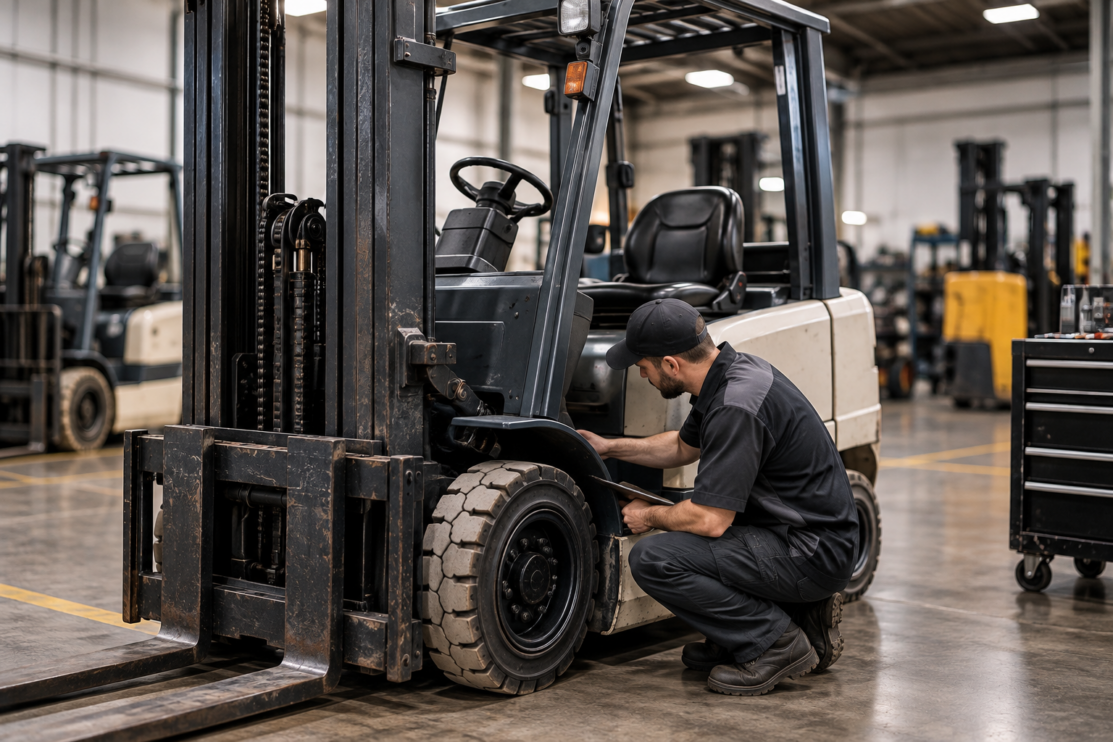
When Does Buying a Pre-Owned Forklift Make Sense for Your Business?
What to Consider Before Investing in a Pre-Owned Forklift
Investing in a forklift does not always mean purchasing brand-new equipment.
For many warehouses, manufacturing facilities, contractors, distribution centers, and other businesses, a quality pre-owned forklift can provide the capabilities they need while allowing them to make better use of their equipment budget.
The key is understanding when used equipment makes sense and knowing what to evaluate before making a purchase.
Price is certainly an important consideration, but it should not be the only one. Equipment condition, operating hours, maintenance history, application requirements, expected utilization, and long-term support can all influence whether a pre-owned forklift is the right investment.
Lift Solutions helps businesses across Nebraska, Iowa, Colorado, Kansas, South Dakota, and surrounding service coverage areas evaluate new, pre-owned, and rental forklift options based on the needs of their individual operations.
Why Consider a Pre-Owned Forklift?
The most obvious advantage of purchasing pre-owned equipment is the potential for a lower initial investment.
However, cost is only part of the equation.
A quality pre-owned forklift may allow a business to:
- Add equipment without the cost of purchasing new
- Expand an existing forklift fleet
- Replace aging or unreliable equipment
- Add backup equipment
- Support a new department or operation
- Handle seasonal or changing workloads
- Access additional capabilities within an existing equipment budget
For the right application, used equipment can provide significant operational value.
Consider How Often the Forklift Will Be Used
Equipment utilization should play a major role in the purchasing decision.
A forklift operating continuously across multiple shifts has very different requirements than equipment used for a few hours each week.
High-utilization applications may justify investing in newer equipment with the latest technology, efficiency improvements, and warranty coverage.
Lower-utilization applications, however, can be excellent candidates for pre-owned equipment.
For example, a forklift used periodically for receiving shipments or moving materials around a smaller facility may not require the same investment as a forklift operating throughout an entire production shift.
Understanding actual equipment utilization helps businesses avoid both underinvesting and overinvesting.
Operating Hours Do Not Tell the Entire Story
One of the first numbers buyers often look at when evaluating a used forklift is operating hours.
Hours are important, but they should never be evaluated alone.
Two forklifts with similar operating hours may have experienced completely different working conditions.
Factors such as the operating environment, maintenance practices, load requirements, operator behavior, and previous application can all influence equipment condition.
A well-maintained forklift with higher hours may sometimes be a better investment than lower-hour equipment that has experienced poor maintenance or demanding operating conditions.
Maintenance History Matters
Maintenance is one of the most important considerations when evaluating any pre-owned forklift.
Regular preventative maintenance can significantly influence equipment reliability and useful life.
When possible, businesses should understand:
- How regularly the forklift was serviced
- Whether recommended maintenance was completed
- What major repairs have been performed
- Whether wear components have been replaced
- The overall mechanical condition of the equipment
Buying from a material handling provider that understands the equipment and can support it after the purchase adds another layer of confidence.
Make Sure the Equipment Fits the Application
A good deal on the wrong forklift is rarely a good investment.
Before purchasing pre-owned equipment, businesses should confirm that the forklift is appropriate for the work it will perform.
Important considerations include:
- Required lifting capacity
- Maximum lift height
- Load dimensions
- Aisle width
- Mast configuration
- Fork dimensions
- Indoor or outdoor use
- Tire type
- Fuel or battery requirements
- Attachment requirements
Selecting equipment based primarily on price can lead to operational limitations later.
The application should always determine the equipment.
Inspect the Mast and Forks
The mast, carriage, forks, and lifting components are critical parts of any forklift.
Businesses evaluating pre-owned equipment should look for signs of excessive wear, damage, or previous repairs.
Fork condition is particularly important because forks experience significant stress throughout normal operation.
An equipment inspection can help identify whether components are in appropriate condition or may require attention before the forklift enters service.
Evaluate Tires and Other Wear Components
Tires can reveal a great deal about how a forklift has been used.
Uneven wear, significant damage, or tires approaching the end of their useful life can create additional expenses shortly after purchase.
Other wear items should also be evaluated, including:
- Brakes
- Hydraulic components
- Chains
- Hoses
- Steering components
- Seats and operator controls
- Lights and safety equipment
Understanding the condition of these components provides a better picture of the true cost of the equipment.
Battery Condition Is Important on Electric Forklifts
When purchasing a pre-owned electric forklift, the battery deserves particular attention.
The condition and remaining useful life of the battery can significantly affect the overall value of the equipment.
Businesses should consider the battery type, age, charging history, performance, and whether the existing charging equipment is appropriate for the operation.
A forklift with an attractive purchase price may become considerably more expensive if a battery replacement is needed shortly afterward.
Evaluating the forklift and its power system together helps provide a more accurate understanding of the investment.
Consider Total Cost of Ownership
Purchase price is only one component of forklift ownership.
Businesses should also consider:
- Expected maintenance
- Energy or fuel costs
- Replacement parts
- Battery requirements
- Equipment downtime
- Expected remaining service life
- Resale value
Looking at total cost of ownership makes it easier to compare new and pre-owned equipment fairly.
In some situations, new equipment may provide the strongest long-term value.
In others, a well-selected pre-owned forklift can deliver the performance the operation requires at a significantly different investment level.
Pre-Owned Equipment Can Help Standardize a Fleet
Businesses working toward forklift fleet standardization do not necessarily have to purchase every unit new.
Pre-owned equipment can sometimes help companies add forklifts that align with equipment already in the fleet.
Matching equipment can simplify:
- Operator training
- Maintenance procedures
- Parts requirements
- Equipment utilization
- Fleet management
This can be especially valuable when a company needs additional capacity but wants to maintain consistency throughout its operation.
When Does Renting Make More Sense?
Purchasing pre-owned equipment is not always the answer.
If a forklift is only needed for a temporary project, seasonal demand, or a short-term increase in workload, renting may provide greater flexibility.
Rental equipment can also help businesses determine whether a particular equipment type is appropriate before making a longer-term investment.
Evaluating new, used, and rental options together allows businesses to select the approach that best fits both operational and financial requirements.
Why the Source of Pre-Owned Equipment Matters
Where a business purchases used equipment can be just as important as the forklift itself.
Lift Solutions maintains a selection of pre-owned forklifts and industrial equipment sourced through its equipment network, industry partnerships, and rental fleet.
Equipment is inspected and serviced in-house, helping customers better understand what they are purchasing.
Working with an established material handling provider also means businesses have access to service, parts, maintenance, and equipment expertise after the sale.
That ongoing support can be particularly valuable with pre-owned equipment.
How Lift Solutions Can Help
Choosing between new, pre-owned, and rental equipment should start with understanding the operation.
Lift Solutions works with businesses to evaluate equipment utilization, facility requirements, workloads, budgets, and long-term goals before recommending a solution.
For some businesses, new equipment will make the most sense.
For others, pre-owned equipment may provide exactly the combination of capability and value they need.
And when equipment requirements are temporary, rentals may offer the flexibility the operation demands.
Having access to all three options allows businesses to make decisions based on what works best for their operation rather than being limited to a single approach.
Find the Right Forklift for the Job
A pre-owned forklift can be a smart investment when the equipment is properly matched to the application and its condition is thoroughly understood.
Rather than focusing only on purchase price or operating hours, businesses should consider equipment condition, maintenance history, utilization, power requirements, operating environment, and total cost of ownership.
Taking the time to evaluate these factors can help businesses purchase equipment that delivers reliable performance while maximizing their investment.
Whether you are replacing an aging forklift, expanding your fleet, or evaluating equipment for a new application, Lift Solutions can help you compare new, pre-owned, and rental options and find the solution that makes sense for your operation.


